
AI Strategy
After AI flattens skill: mastery, agency and identity in the generative era
Generative AI is not only changing how creative work is produced. It is moving the scarce layer of value upward: from execution, to judgement, to agency, and ultimately to identity.
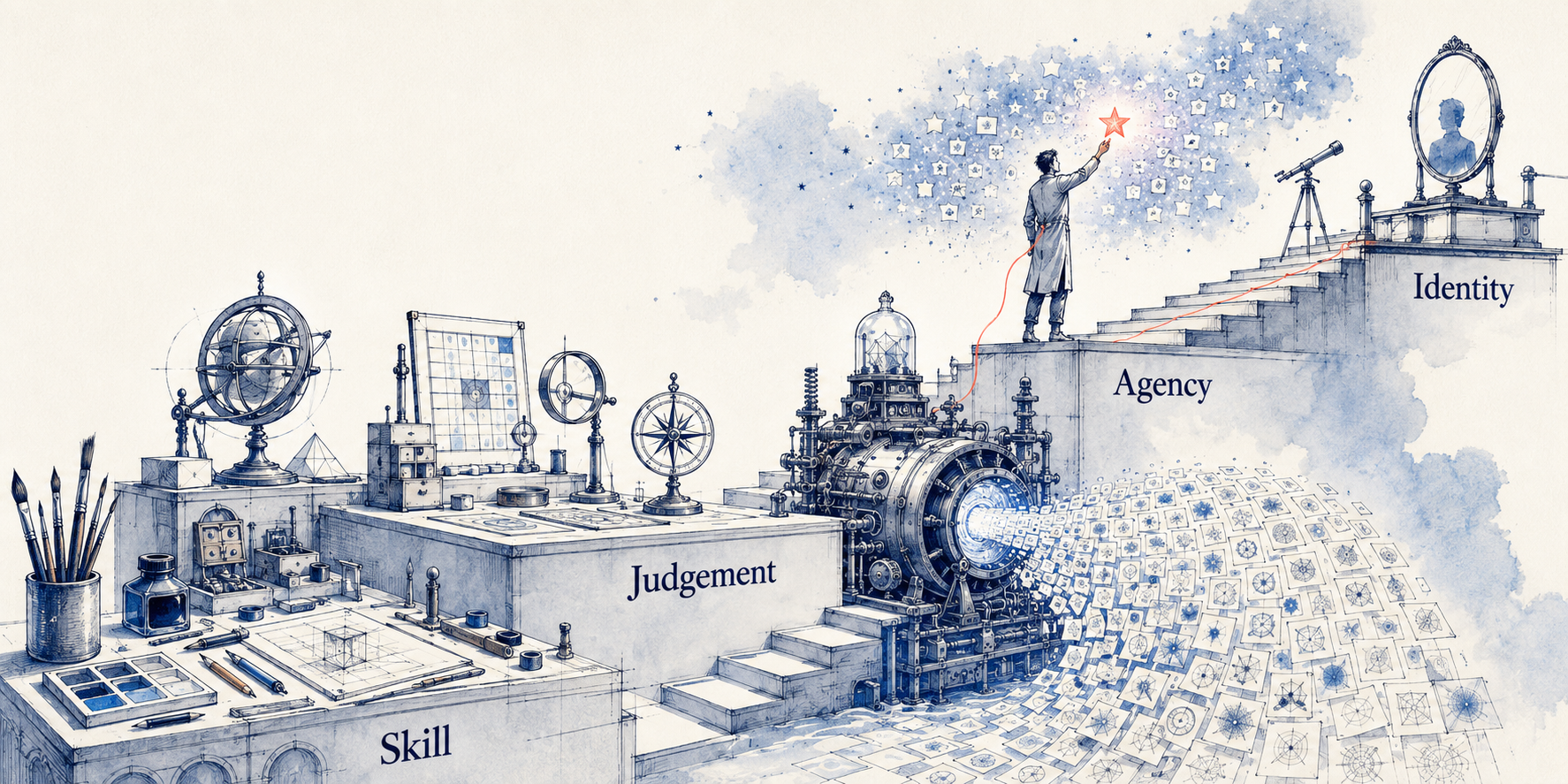
Generative AI has made one question increasingly uncomfortable: when machines can produce expert-looking outputs on demand, what remains scarce in human work?
The creative industry gives us a useful lens. Consider the classic challenge of asking artists to match a world-class concept artist: a complex fantasy character, highly finished, structurally believable, visually memorable and culturally loaded. In the pre-generative era, the finished image itself was a high barrier. It compressed years of training into one artefact: drawing, anatomy, material control, composition, visual memory, symbolic language and taste.
In 2026, that barrier is no longer stable.
A capable user with Midjourney, Flux, GPT Image, Stable Diffusion or similar tools can generate dozens of visually striking images in hours. Armour, cinematic lighting, ornate costumes, mythic settings and high-density fantasy detail are exactly the kinds of domains where current image models perform well. If the contest is only about the first impression of a single image, AI can flood the field with plausible excellence.
But that does not mean AI has captured mastery. It means the visible surface of mastery has become cheap to imitate.
A beautiful image is not the same as a design system
The deeper test begins when we stop asking for one final image and start asking for a coherent object.
A professional concept design is not merely a rendered surface. It is a system of constraints:
- the same character must remain consistent from front, side and back;
- armour plates must connect through plausible hinges, straps, joints and load paths;
- weapons must be held, carried and moved by a real body;
- patterns should carry cultural or narrative logic rather than decorative noise;
- anatomy, fabric, metal, leather, lighting and silhouette must remain mutually consistent;
- the character must survive different poses, lenses, lighting setups and production needs;
- the designer should be able to explain why the key decisions were made.
This is where the difference between generating a compelling image and designing something that exists becomes visible.
A top concept artist does not simply know how to place pixels. They carry an internal model of the character, the material culture, the production constraints and the world. The pixels are a projection of that model.
Current AI systems are improving rapidly, but they still often reveal weaknesses in structural continuity, cross-view consistency, persistent identity and design causality. They can produce local brilliance while losing global coherence. A glove changes. A strap disappears. A weapon becomes impossible to hold. A symbol looks significant but has no narrative function.
For now, these failures expose the remaining value of professional craft.
But it would be a mistake to treat them as permanent protection.
Today’s creative moat is tomorrow’s engineering feature
Many of the constraints that currently distinguish expert designers from AI are not metaphysical. They are technical.
Three-view consistency is, in part, a problem of state representation. Multi-pose consistency is a problem of persistent identity, skeletons, topology, costume graphs and semantic constraints. Material continuity is a problem of structured asset representation. Design rationale can be modelled as briefs, constraints, trade-offs and decisions.
In other words, much of what currently looks like “human-only craft” can be reframed as:
state maintenance + constraint satisfaction + long-horizon consistency + world modelling + verifiable reasoning.
Those are precisely the capabilities AI systems are being pushed to improve.
Future image systems may not generate each frame as a fresh approximation of a prompt. They may first create a persistent latent asset or scene representation, then render views, poses, lighting conditions and variations from that stable state. Once that happens, consistency stops looking like a master-level achievement. It becomes the default property of the tool.
No one is impressed that a CAD model remains consistent when rotated 360 degrees. That consistency is assumed because the underlying object exists in the system.
The same may happen to creative design. Today we say, “Amazing — the three views match.” Tomorrow we may ask, “Why would they not match?”
The defensive line will then retreat.
At first, mastery meant: I can draw what others cannot.
Then it became: I can design what others cannot.
Soon it may become: I can direct AI systems better than others.
Later still: I know what is worth designing.
Eventually: I decide what should exist.
This is the fundamental shift: scarcity moves upward.
From execution scarcity to judgement scarcity
For most of industrial history, execution was expensive. Producing a strong artefact required scarce skill, specialised labour and time. That made capability itself the moat.
Generative AI changes the economics. It compresses execution cost and expands the search space. When production becomes abundant, the strategic question changes from:
Can we make this?
To:
Among all the things we could make, why this one?
This is the movement from execution scarcity to judgement scarcity.
The same pattern appears outside art. In software, AI can generate code, tests, documentation and prototypes. In enterprise architecture, AI can draft target states, migration plans, policies and operating models. In marketing, AI can produce campaigns, variants and customer segments. In strategy, AI can generate option sets faster than most teams can review them.
The scarce capability is no longer only production. It is deciding what should be produced, what should be rejected, what should be simplified, what should be governed and what should never be automated.
However, even judgement is not a safe final boundary.
AI can analyse user preferences, cultural context, market trends, aesthetic history, novelty, emotional response, commercial conversion and expert evaluation. It can rank 10,000 design directions by originality, audience fit, narrative potential and execution feasibility. It can surface a Pareto frontier of options that no human team would have had time to explore.
At that point, “I can choose better than AI” may also become a fragile claim.
So the human role retreats again — from skill, to judgement, to agency.
Agency is not skill. It is authorship under responsibility
Agency asks a different question.
Not: Can you do it?
Not even: Can you judge it?
But: Is this the world you choose to bring forward?
AI can propose thousands of excellent futures. It can predict your preferences, recommend your likely choice and perhaps understand your taste better than you do in many narrow domains. But in our current social, legal and moral systems, someone still has to say:
Yes. This one.
That moment is not merely an optimisation step. It is an act of authorship.
It carries responsibility. It binds an artefact to an accountable subject. It turns an output into a decision.
This matters for enterprise AI as much as it matters for creative work. As AI systems become more capable, organisations will face fewer questions about whether something can be generated and more questions about who owns the decision to use it:
- Who approved this design direction?
- Who accepted the risk?
- Who decided this customer experience should exist?
- Who chose this policy trade-off?
- Who is accountable when the system is technically correct but socially wrong?
The mature AI organisation will not be defined by how much content, code or analysis it can generate. It will be defined by the quality of its decision boundaries.
Does this erase the difference between masters and everyone else?
If AI gives everyone expert execution, expert structure, expert options and expert recommendations, does mastery itself collapse?
Partly, yes.
The traditional concept of a master as someone who can perform a rare skill far beyond the general population may weaken dramatically. If everyone can access master-level production through AI, then “who can make this?” becomes less important.
But equal access to agency does not mean equal depth of agency.
Two people may both receive 10,000 technically valid designs from the same AI system. One chooses the option that looks coolest. Another chooses a quieter option because it connects a cultural memory, an emerging social anxiety and a new visual language that can sustain an entire body of work.
Both made a choice. The choices are not equal in depth.
The gap shifts from execution gap to meaning gap.
In the past, the master’s advantage was:
I can do what you cannot.
In the AI era, it may become:
I can see what you do not yet see.
This is less like a sports competition and more like investing, research or cultural leadership. Everyone can buy a stock. The button is not scarce. What separates a disciplined investor from a casual participant is the ability to build a framework, act under uncertainty, remain coherent over time, see value before consensus forms and bear the consequences of the decision.
Creative mastery may evolve in the same direction. The important unit will not be a single brilliant artefact. It will be a sustained pattern of choices:
- taste over time;
- worldview over time;
- coherence under abundance;
- the ability to reject attractive but shallow options;
- the ability to connect technical possibility with human meaning.
The final scarce layer may be identity
There is an even more radical possibility. AI may eventually assist not only execution and judgement, but also meaning discovery, long-term strategy, cultural interpretation and value selection. If that happens, the gap between master and non-master as a capability hierarchy may approach collapse.
But something else becomes important: provenance.
A work may matter not because no one else could technically create it, but because of who chose it, why they chose it and what life it came from.
AI can simulate a song written after losing a parent. It may even generate a technically excellent one. But a song chosen and released by someone who actually lived that loss carries a different social meaning. The distinction is not only in the output. It is in the relationship between output, experience and personhood.
That is why the long-term arc may look like this:
Skill → Judgement → Agency → Identity
Skill can be automated. Judgement can be augmented. Agency can be predicted and shaped. But identity changes the nature of the question.
The question becomes not “who is more capable?” but “who is speaking?”
Strategic takeaway
Generative AI will not simply make creative work faster. It will restructure the meaning of expertise.
The visible surface of mastery will become easier to reproduce. Many current professional moats — consistency, structure, iteration, even rationale — will be weakened as AI systems gain persistent state, world models and stronger reasoning. The defensible layer will keep moving upward.
For individuals, the challenge is to develop a point of view that survives abundance.
For organisations, the challenge is to build systems where AI accelerates production without erasing accountability, taste, governance and strategic intent.
The future master may not be the person who can execute far beyond everyone else. It may be the person whose choices, sustained over time, change how others understand what is worth making.
AI may be able to challenge a master’s image.
That is not the same as possessing the master.
And when every image becomes possible, the deepest question will no longer be whether we can create it.
It will be why this person, this organisation, or this culture chose this one.