
Enterprise Architecture
Agent evaluation is a control plane (not a dashboard)
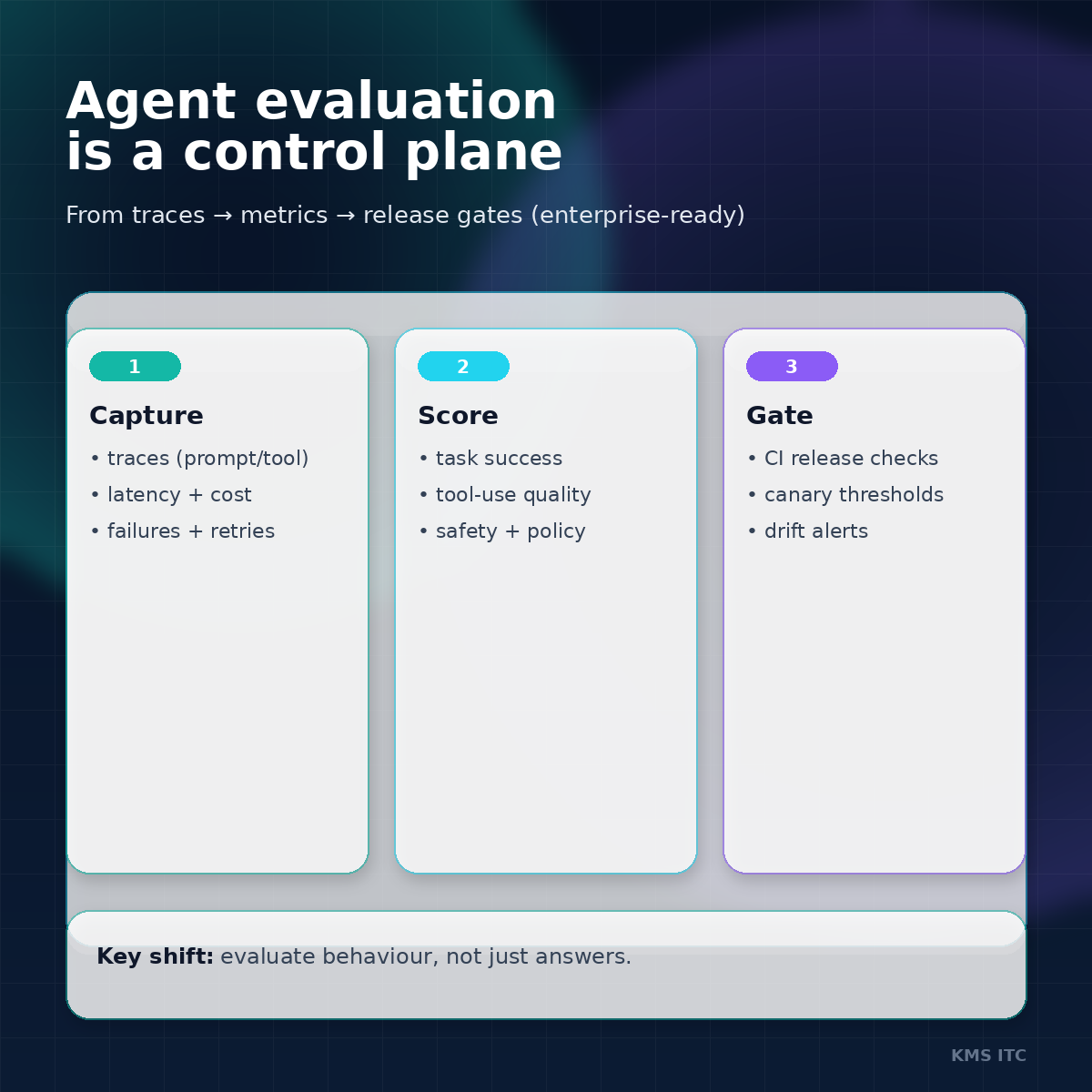
Agentic systems fail in tool-use, memory, and recovery—not just ‘wrong answers’. Treat evaluation like a control plane: traces → metrics → release gates, with scorecards that point to root causes.
If your system is prompt → answer, evaluation is mostly about output quality.
If your system is an agent, evaluation is about behaviour over time:
- did it choose the right tool?
- did it call the tool correctly (parameters, auth, retries)?
- did it recover from failures without looping or escalating blast radius?
- did it stay inside policy boundaries?
- did it finish within latency and cost budgets?
That’s why “one score” dashboards often fail in production: they tell you the agent is worse, but not why.
The architectural move is to treat evaluation as a control plane.
1) The core pattern: traces → metrics → release gates
In large enterprises, the hard part isn’t writing an evaluator—it’s making evaluation repeatable, auditable, and enforceable across teams.
A practical reference architecture flows through four stages:
- Trace capture → structured records of every agent run (prompts, tool calls, parameters, timings, errors, cost)
- Evaluation service → score traces against agreed metrics using LLM-as-judge, algorithmic measures, or human review
- Scorecard publication → results stored as artefacts tied to the release candidate
- Release gate → automated pass/fail decisions enforced in CI/CD before promotion
What this enables
- Standard inputs: trace format is consistent (agent runs become replayable artefacts)
- Comparable metrics: teams share a common score vocabulary
- Change control: releases are gated by measurable thresholds (not vibes)
- Ops readiness: production drift becomes detectable early
The uncomfortable tradeoff
Treating evaluation as a control plane introduces platform overhead:
- trace capture/storage costs
- evaluator maintenance
- governance around what “success” means per use case
But the alternative is worse: uncontrolled agent behaviour shipped behind an API.
2) Don’t grade only outcomes—grade components
Agents fail “mid-flight”:
- good plan, wrong tool
- right tool, wrong parameters
- correct tool call, auth timeout
- correct retrieval, incorrect synthesis
If you only grade the final answer, these all look the same.
Instead, build scorecards that separate:
- Outcome metrics (did the task complete?)
- Component metrics (where did it break?)
- Model metrics (is this a model choice or a system design issue?)
A useful mental model
If an agent is a distributed system, then:
- traces are your logs
- metrics are your SLOs
- release gates are your change management
3) Enterprise guardrails: define gates that match your blast radius
A control plane becomes valuable when it can stop bad changes.
Start with three gate types:
Gate A — Success
- task success rate on a golden set
- regression threshold (e.g., “no more than -2% vs last release”)
Gate B — Safety / policy
- data boundary violations (PII/secret leakage)
- restricted tool access (e.g., “no write actions in sandbox tier”)
- hallucination-sensitive domains (finance/legal/medical)
Gate C — Budget (latency + cost)
- p95 latency threshold
- token/tool-call budget per task
- “failure loop” detection (retries without progress)
Architectural implication: your platform needs a notion of agent tiers (sandbox → internal → customer-facing → regulated) so gates can tighten as risk increases.
4) What to do next (a 2-week blueprint)
If you’re scaling agents across teams, this is a pragmatic start:
- Instrument traces first (prompt + tool calls + errors + timings + cost)
- Create a golden set (happy path + edge cases + “known bad” prompts)
- Implement component metrics for tool-use and recovery (not just output grading)
- Add CI release gates (success/safety/budget)
- Stand up drift monitoring in prod (alerts + periodic human audit)
If you do only one thing: make every score link back to a replayable trace.
Sources
If you want, I can share a lightweight agent evaluation template (trace schema + scorecard layout + CI gates) that teams can adopt in a week.
Reply with EVAL CONTROL PLANE and tell me your environment (AWS/Azure/GCP, and whether you’re using LangChain/LangGraph/Strands/other) and I’ll tailor it.