
AI & Cloud Architecture
Stateful AI agents arrive on Bedrock: what the AWS–OpenAI runtime means for enterprise architecture
AWS and OpenAI's new Stateful Runtime Environment shifts AI agents from fire-and-forget prompts to persistent, memory-bearing workflows—and it changes what enterprise architects need to plan for.
The biggest announcement in enterprise AI this week isn’t a new model—it’s a new runtime. AWS and OpenAI have unveiled a multi-year partnership that includes a Stateful Runtime Environment delivered through Amazon Bedrock, purpose-built for AI agents that need to retain context, access memory, and orchestrate across tools over long-running workflows.
This is a meaningful architectural shift. Here’s why it matters and what to do about it.
From stateless prompts to stateful agents
Most enterprise AI today is stateless: a request goes in, a response comes out, context is discarded. Building anything persistent—multi-step workflows, agents that remember prior decisions, processes that span hours or days—requires teams to build and maintain their own state management, memory stores, and session infrastructure.
The Stateful Runtime Environment changes the default:
| Stateless (today’s baseline) | Stateful Runtime (Bedrock) |
|---|---|
| Context lost between calls | Persistent memory across sessions |
| State management is your problem | Runtime-managed state and context |
| Each call is isolated | Agents work across tools and data sources continuously |
| Short-lived, single-turn interactions | Long-running, multi-step workflows |
This isn’t just a convenience feature. It removes a significant infrastructure burden that has been one of the primary reasons enterprise agent projects stall between prototype and production.
What the architecture looks like
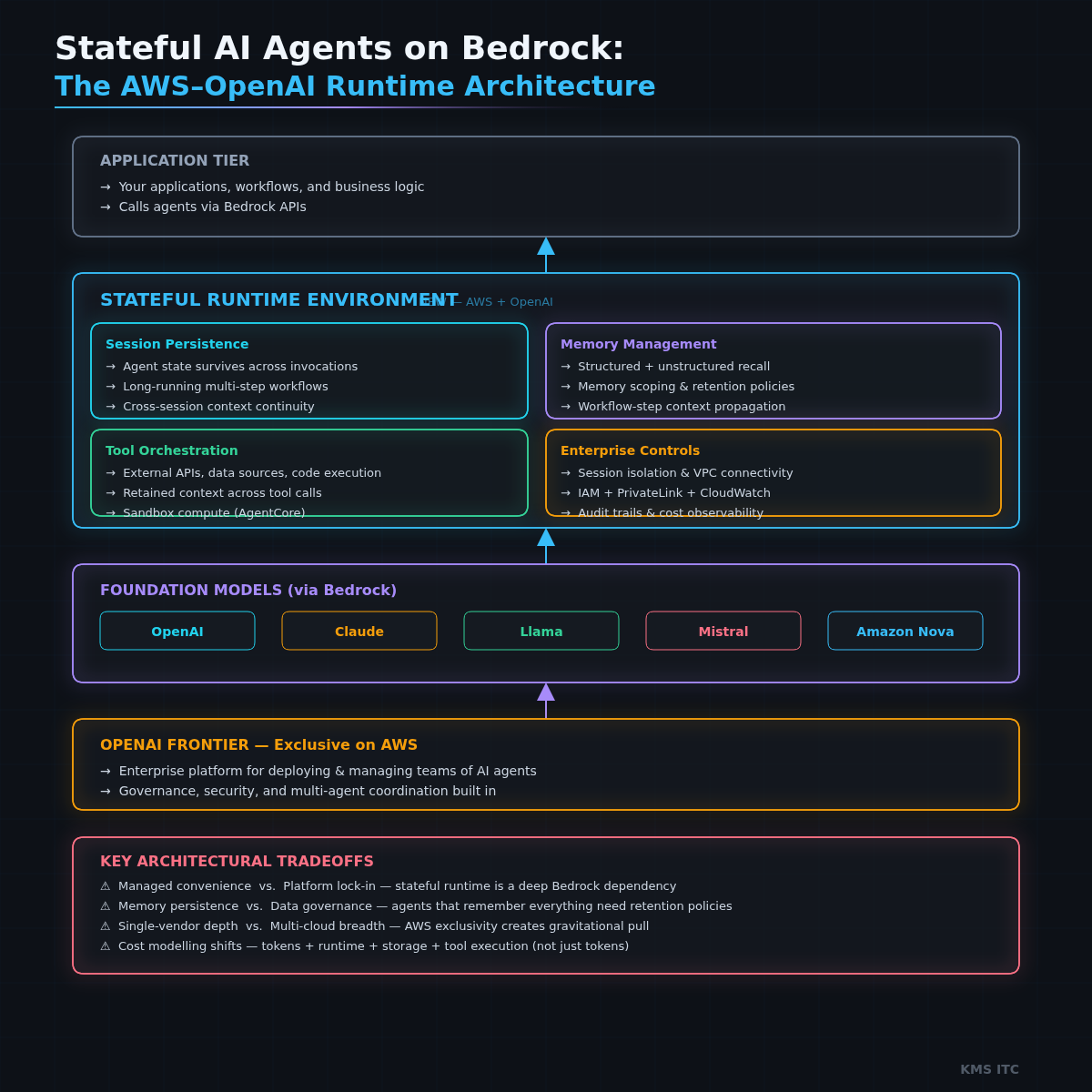
The Stateful Runtime Environment sits as a new layer between your application logic and the foundation models:
Application tier → calls agents via Bedrock APIs
Stateful Runtime (new) → manages:
- Session persistence — agent state survives across invocations
- Memory management — structured and unstructured recall across workflow steps
- Tool orchestration — agents call external tools, APIs, and data sources with retained context
- Compute access — agents can execute code and interact with infrastructure
Foundation models → OpenAI models (initially) via Bedrock, alongside existing Anthropic, Meta, Mistral, and Amazon models
Enterprise controls → session isolation, VPC connectivity, PrivateLink, IAM integration, CloudWatch observability
Key architectural implications
1. State is now a platform concern, not an application concern. Teams no longer need to build bespoke session stores, context windows, or memory retrieval systems. The runtime handles it. This is analogous to how managed databases removed the need for teams to operate their own storage engines.
2. Agent portability gets harder. If your agents depend on Bedrock’s stateful runtime for memory and session management, you’ve taken a meaningful platform dependency. Multi-cloud agent strategies need to account for this—either by abstracting the state layer or accepting the coupling.
3. Security boundaries shift. Stateful agents that persist memory and access multiple tools over time have a larger blast radius than stateless calls. Session isolation, data retention policies, and memory scoping become critical governance concerns.
4. Cost modelling changes. Stateful agents consume resources between invocations—memory storage, session compute, tool execution. The cost model moves from pure token pricing toward a blend of tokens + runtime + storage. Bedrock AgentCore’s pricing already reflects this with per-session and per-tool-execution charges.
The OpenAI Frontier angle
The partnership also makes AWS the exclusive third-party cloud distribution provider for OpenAI Frontier—OpenAI’s enterprise platform for deploying and managing teams of AI agents. This means enterprises already on AWS get a managed path to OpenAI’s most capable models and agent infrastructure without leaving their existing cloud governance perimeter.
For organisations running multi-model strategies on Bedrock (Anthropic Claude, Meta Llama, Mistral, Amazon Nova alongside OpenAI), this consolidation simplifies procurement and governance—but deepens the Bedrock platform dependency.
The tradeoffs to navigate
Managed convenience vs. lock-in. The stateful runtime removes undifferentiated heavy lifting, but it’s a deep platform bet. Architects should evaluate whether the state layer can be abstracted (e.g., using an open orchestration framework like LangGraph or Semantic Kernel on top) or whether the Bedrock-native approach is acceptable.
Memory persistence vs. data governance. Agents that remember everything are powerful—and a potential compliance liability. Enterprises need clear policies on what agents can store, for how long, and who can access agent memory. This is especially critical in regulated industries.
Single-vendor depth vs. multi-cloud breadth. The AWS–OpenAI exclusivity creates a strong gravitational pull. Enterprises with Azure OpenAI Service investments need to evaluate how Frontier and the stateful runtime compare with Azure’s own agent infrastructure (Copilot Studio, Semantic Kernel, Azure AI Agent Service).
What to do next
-
Evaluate stateful runtime fit. If your agent use cases involve multi-step workflows, long-running processes, or cross-system orchestration, the stateful runtime addresses real pain points. Map your agent portfolio against it.
-
Define memory governance early. Before deploying stateful agents, establish data retention policies, memory scoping rules, and audit requirements. Treat agent memory like a data store—because it is one.
-
Assess platform coupling. Decide whether Bedrock-native state management is acceptable for your organisation, or whether you need an abstraction layer to preserve optionality.
-
Revisit your cost model. Token-based cost projections undercount stateful agent spend. Factor in session persistence, tool execution, and memory storage when building business cases.
-
Watch KubeCon Europe (March 23–26). The cloud-native community will respond to this with open-source alternatives and patterns for stateful agent orchestration on Kubernetes. The CNCF ecosystem rarely lets a proprietary capability go unchallenged for long.
Sources
- AWS Weekly Roundup: OpenAI partnership, Elemental Inference, Strands Labs (March 2, 2026) — AWS News Blog
- Amazon and OpenAI unveil $50B AI partnership on AWS — EdTech Innovation Hub
- Amazon Bedrock AgentCore — AWS
- Building AI Agents in AWS: A Hands-On Bedrock Walkthrough — InterWorks
Are you evaluating Bedrock’s stateful runtime for your agent architecture? We’d love to hear how you’re thinking about the tradeoffs between managed convenience and platform independence. Share your take.