
AI Strategy
The state of physical AI at the edge
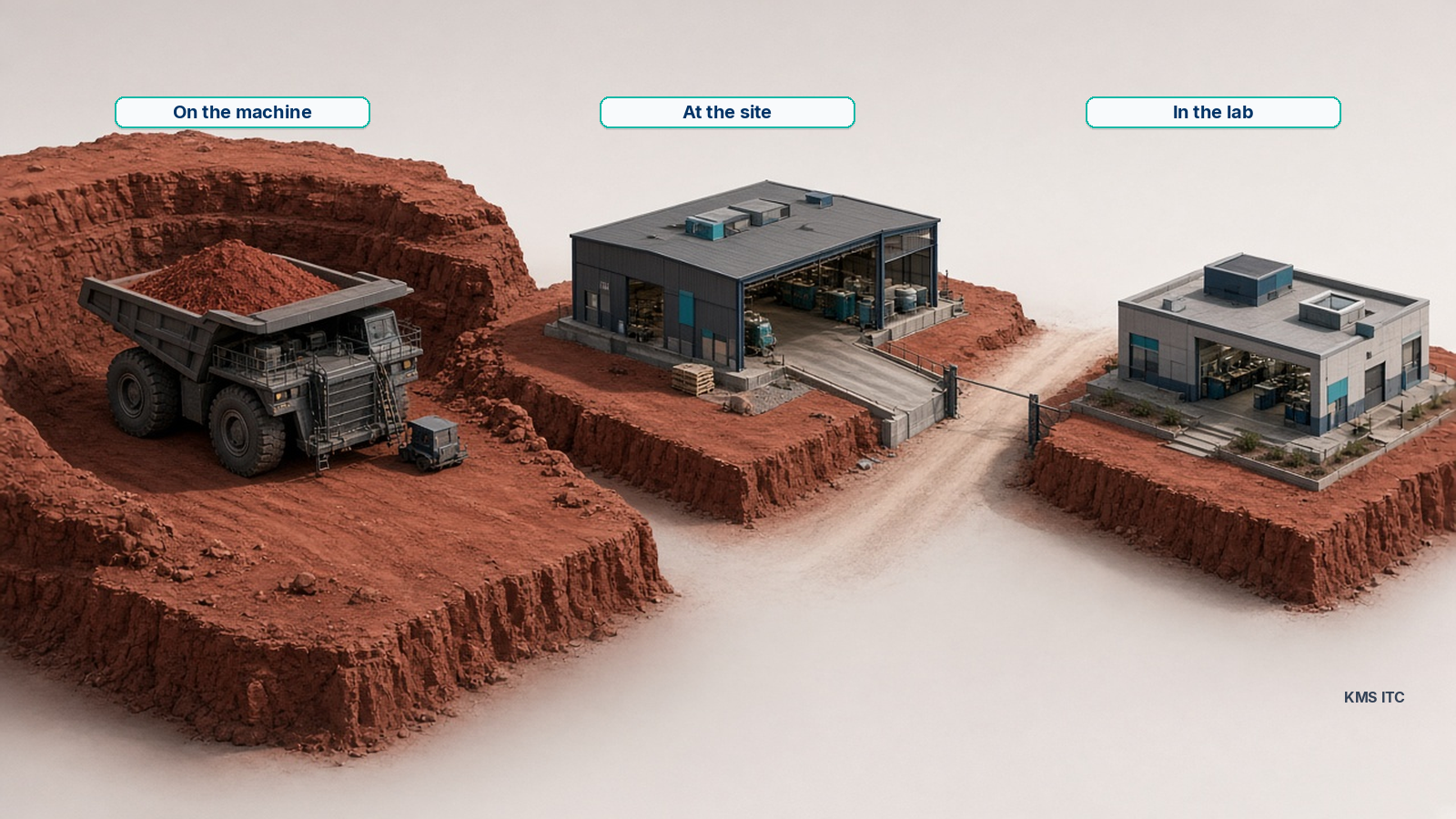
Physical AI is a placement decision. The safety stop stays on the machine, the site may coordinate, and the lab only releases a policy. A dropped link must not move the stop.
Executive summary
- Put the safety stop and the next action on the machine. Put the queue, the log and the model registry at the site. Put simulation, fine-tuning and the release gate in the lab.
- A quoted rate is a replanning rate unless the vendor says otherwise. On NVIDIA’s GR00T N1.7 table, Jetson AGX Thor reaches 12.4 Hz with TensorRT, for four denoising steps and one camera. About 10 Hz of replanning can still feed motion near 30 frames per second.
- Thor-class modules and Qualcomm’s Dragonwing IQ10 are the computers that can hold a current vision-language-action policy. A Hailo-10H, at a typical 2.5 W, is a camera accelerator. Do not compare sparse INT8 TOPS with sparse FP4 TFLOPS.
- In the Pilbara the production pattern is already autonomous haulage and site inspection. A humanoid is a later, gated experiment. ISO 10218-1:2025 does not cover underground use, explosive atmospheres, or climates outside the manufacturer’s specification.
The safety stop stays with the machine. The site can coordinate. The lab prepares a policy, and the road to the lab is allowed to break.
What changed
The hardware for an on-robot policy arrived in two steps, and neither step is a hobby board.
On 25 August 2025 NVIDIA made the Jetson AGX Thor Developer Kit and the T5000 module generally available. Thor is a Blackwell module with 128 GB of memory, rated up to 2,070 sparse FP4 TFLOPS inside a 40–130 W envelope. Against Jetson AGX Orin, NVIDIA quotes up to 7.5 times the AI compute and 3.5 times the energy efficiency.
On 15 July 2026 NVIDIA announced the smaller T3000 and T2000 modules, scheduled for the first quarter of 2027. The T3000 is rated at 865 FP4 TFLOPS with 32 GB, in a package described as roughly half the size and power of the T5000. The T2000 is rated at 400 FP4 TFLOPS with 16 GB. NVIDIA pairs the IGX T3000 with Halos, its robotics safety stack, and tied a T3000 emulation mode to JetPack 7.2.1. The same note describes Cosmos 3 Edge as a 4-billion-parameter model that can be post-trained for one embodiment in about a day and then run on Thor. Treat “about a day” as NVIDIA’s claim for that post-training step.
Qualcomm’s January 2026 answer is the Dragonwing IQ10: up to 700 sparse INT8 TOPS, also stated as 350 dense INT8 TOPS, an 18-core Oryon CPU, and up to 20 cameras. The product brief describes a safety subsystem planned up to SIL 3. Those TOPS are not comparable with Thor’s FP4 TFLOPS. The only useful number is latency on your model, on that silicon.
Under both sits a different part. A published Hailo-10H M.2 datasheet lists 40 INT4 TOPS and 20 INT8 TOPS at a typical 2.5 W. That is the right shape for a camera pipeline beside a host. It is the wrong shape for a multi-billion-parameter policy.
The open checkpoints draw the same line in memory rather than in marketing units. openpi ships π0, π0-FAST and π0.5, pretrained on more than 10,000 hours, and asks for more than 8 GB to infer, more than 22.5 GB for LoRA, and more than 70 GB for a full fine-tune. SmolVLA, released on 3 June 2025, is 450 million parameters and is described as runnable on a CPU, a consumer GPU or a MacBook. OpenVLA, at 7 billion parameters and 970,000 demonstrations, is a research baseline its authors serve in bfloat16 on a 16 GB GPU. Gemini Robotics On-Device 2 is not a download: trusted testers, fewer than 200 examples to adapt a new robot, and a model card scoped mainly to bi-arm work.
Why placement is the architecture
A vision-language-action model takes cameras, robot state and a language instruction, and emits a chunk of actions. The chunk is why the model does not have to replan at the actuator rate. NVIDIA’s hardware note for GR00T N1.7 separates the machines. N1.7 is about 3 billion parameters. Fine-tuning wants 40 GB or more; the default recipe tunes the projector and the action head, not the whole backbone. With TensorRT, four denoising steps and one camera, AGX Thor reaches 12.4 Hz, a 64 GB Orin 6.6 Hz — slow tasks only — and an H100 35.9 Hz. Those figures are new action chunks, not motion. NVIDIA says about 10 Hz of replanning can still sustain execution near 30 frames per second.
A separate Jetson AI Lab result is not the catalogue figure. Mixed NVFP4 on an AGX Thor in MAXN mode took a GR00T 1.7 LIBERO run from about 126 ms to about 40 ms, with task success reported on par with PyTorch. That is about 25 Hz on that benchmark.
The non-obvious point is what those numbers do not buy. A world model such as Cosmos Transfer or Predict can change lighting and layout while Isaac Sim holds the motion still. That is a data plane. A new background is not contact physics, and simulated contact is not the site. The policy that leaves the lab is a release artefact. It is not a remote driver.
Where each function is owned
On the machine: the safety stop, the sensors, the state estimate, and a policy only if it can emit the next chunk in time. Power and memory are fixed. This function has one owner, and the owner is local.
At the site: the task queue, the fleet picture, logs, the registry, and any heavier model you will run only while the local network holds. A workshop server belongs here. A control room in Perth does not.
In the lab: training, simulation, synthetic data and the gate that allows a checkpoint onto a machine. World models live here. They manufacture experience. They are not in the control loop.
ISO 10218-1:2025, published in February 2025, draws a similar boundary in law. It covers the industrial robot as partly completed machinery. Integration is Part 2. The scope excludes underground use, explosive atmospheres, and severe conditions outside the manufacturer’s specification. The 2025 revision brought collaborative-application rules, formerly ISO/TS 15066, into the standard, and added cybersecurity where it can affect safety. NVIDIA Halos is a way to assemble evidence for standards such as IEC 61508 and ISO 13849. It is not the application’s risk assessment. DeepMind’s on-device model card says the same thing in product language: safety is a reasoning model, a low-level controller, and hardware functional safety, not a property of the action tokens.
How a cycle runs
Two paths share the hardware and must not be drawn as one arrow.
The live cycle stays on the machine. Sensors update state. The safety monitor can stop or hold without waiting for a model. If a resident policy is loaded, it emits a chunk. If the site is serving a heavier model, that call has a timeout, and the timeout returns to the local hold. The lab is not on this path.
The release path runs the other way, and only when you choose to ship. The lab passes an evaluation gate. The site registry stores the checkpoint. The machine receives it. A dropped link does not promote the lab into the loop, and it does not invent a cloud fallback for the brakes.
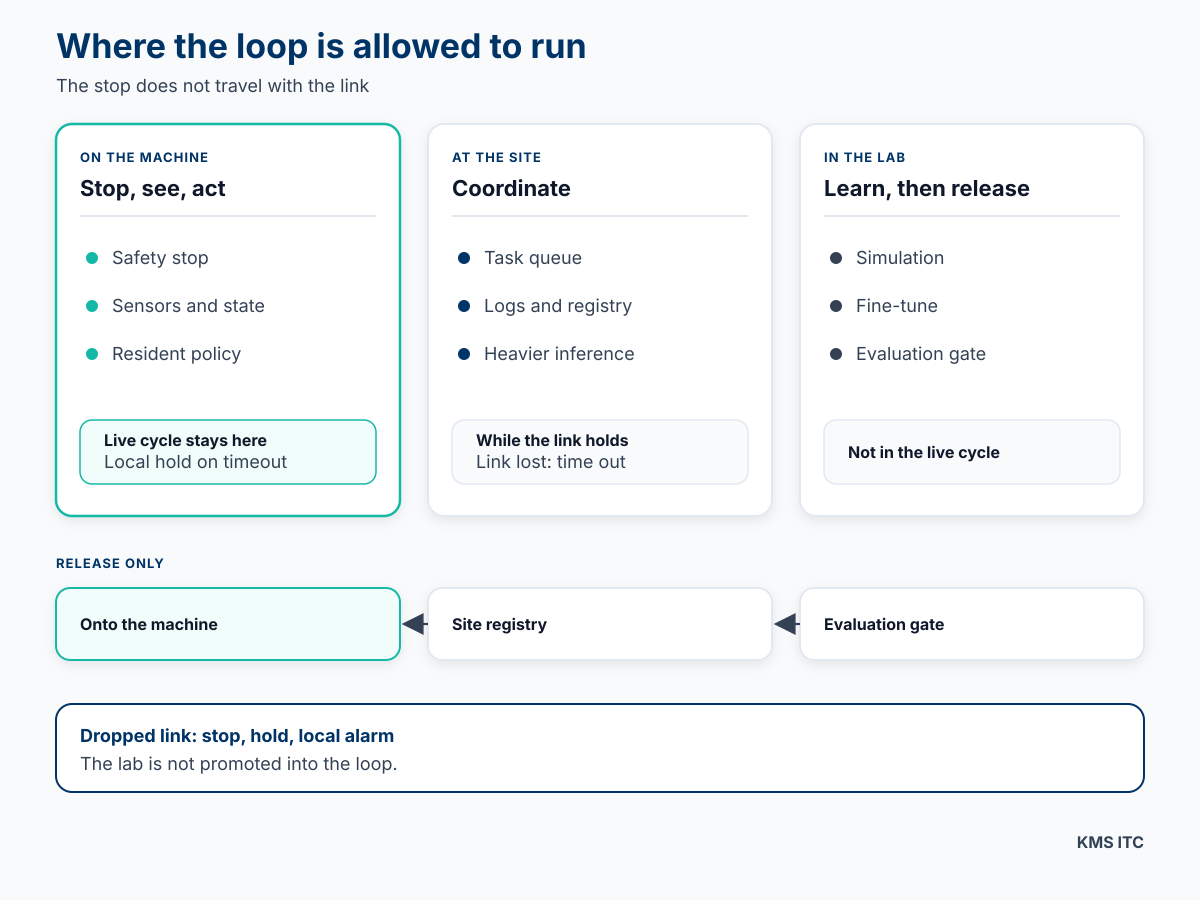
A dropped link returns the machine to a local hold. It does not move the laboratory into the control loop.
How to adopt it
- Write the failure mode before the model. If the link to site and the link onward both drop, a safe stop, a local hold and a perception alarm must still work on the machine.
- Separate the clocks. Camera rate, replanning rate, actuator rate and the safety monitor are four numbers. A 12 Hz policy is not a 12 Hz robot.
- Pick the checkpoint by memory and by who is allowed to have it. SmolVLA-class models suit a small arm on a modest board. GR00T-class models assume a 40 GB-class fine-tune and Thor-class memory. Gemini Robotics On-Device remains a partner programme.
- Use world models to vary light and layout, then measure the task on the real machine and count interventions.
- Keep the safety function outside the net. If the work is underground, explosive, or outside the robot’s specified climate, say so before the purchase order.
- Start where a decision already exists: inspection, a repeatable workshop task, or a check on equipment you already maintain. Add language and mobility when that loop is boringly reliable.
Where this fails
BMW’s 25 June 2026 release says a Figure 02 at Plant Spartanburg supported production of more than 30,000 X3 vehicles over ten months by inserting sheet-metal parts. Figure’s account adds an 11-month deployment, ten-hour weekday shifts, more than 90,000 parts and more than 1,250 hours, and the targets it set: an 84-second cycle, placement above 99 per cent per shift, zero interventions, and placement within 5 millimetres in two seconds. Those are targets. The achieved rates are not in the public note. Figure 03 has since moved to logistics sequencing. Copy the measurement habit. Do not copy the headline.
The same honesty applies to fleet numbers. A BBC report dated 8 November 2024 described Rio Tinto’s Perth Operations Centre coordinating more than 360 self-driving trucks, about 84 per cent of that fleet, plus autonomous rail and nearly 40 drills, on the order of 1,500 kilometres from the mines. Rio’s own pages describe drills planned from Perth, and drones used for high-wall mapping and thermal inspection. Fortescue’s Hive describes more than 200 autonomous haul trucks and about 500 million tonnes moved autonomously a year. The Rio truck count is a 2024 report, not a census repeated for this note. Supervision can sit in Perth. The decision to stop cannot.
A 2026 AusIMM paper is the nearer pattern: a mid-trial, side-of-road thermal scan in a Pilbara pit, solar skids and a vision model, checking haul-truck tyres without slowing the fleet. From January to March 2026 the authors report 28 of 36 early-life failures detected, with an average of 8.8 days from first detection to removal. That is a maintenance decision, made where the truck already is.
Expert checkpoints fail closed in a quieter way. openpi says the tuned arms may not transfer. A policy that looked general in the lab and misses on your gripper is a release that should not have passed the gate.
What to check before a pilot
- Name the owner of the stop, the owner of the log, and the owner of the release.
- State the timeout, and the behaviour when it fires.
- Record which clock a quoted hertz belongs to, and the benchmark behind it.
- Confirm the checkpoint fits, including the runtime, not only the weight file.
- Count interventions. Publish the target and the result, or do not claim the result.
- Check the environment against ISO 10218-1 before you treat the standard as cover.
- Refuse a diagram that draws the laboratory into the live loop.
The architecture that lasts can say, for each function, where it runs, how fast it must answer, and what evidence would make you turn it off.
Sources
- NVIDIA, Introducing NVIDIA Jetson Thor (25 August 2025): https://developer.nvidia.com/blog/introducing-nvidia-jetson-thor-the-ultimate-platform-for-physical-ai/
- NVIDIA, Jetson Thor product page: https://www.nvidia.com/en-us/autonomous-machines/embedded-systems/jetson-thor/
- NVIDIA, New Jetson Thor computers for mainstream robotics and edge AI (15 July 2026): https://blogs.nvidia.com/blog/jetson-thor-robotics-edge-ai-agent/
- Qualcomm, Robotics technologies announcement (January 2026): https://www.qualcomm.com/news/releases/2026/01/qualcomm-introduces-a-full-suite-of-robotics-technologies-power.md
- Qualcomm, Dragonwing IQ10 Series: https://www.qualcomm.com/internet-of-things/products/iq10-series.md
- Qualcomm, Dragonwing IQ10 Series product brief: https://docs.qualcomm.com/doc/87-A2811-1/87-A2811-1_REV_A_Qualcomm_Dragonwing_IQ10_Series_Platform_Product_Brief.pdf
- AAEON, Hailo-10H M.2 module datasheet: https://newdata.aaeon.com.tw/DOWNLOAD/2014%20datasheet/Boards/Hailo-10H%20M.2%202280.pdf
- NVIDIA Isaac GR00T, Hardware recommendations (N1.7): https://github.com/NVIDIA/Isaac-GR00T/blob/main/getting_started/hardware_recommendation.md
- Jetson AI Lab, Isaac GR00T 1.7 on Jetson Thor: https://www.jetson-ai-lab.com/tutorials/groot_n17_on_thor/
- Physical Intelligence, openpi: https://github.com/Physical-Intelligence/openpi
- Google DeepMind, Gemini Robotics On-Device 2: https://deepmind.google/models/gemini-robotics/on-device/
- Google DeepMind, Gemini Robotics On-Device 2 model card: https://deepmind.google/models/model-cards/gemini-robotics-on-device-2/
- Hugging Face, SmolVLA (3 June 2025): https://huggingface.co/blog/smolvla
- Shukor et al., SmolVLA (arXiv:2506.01844): https://arxiv.org/abs/2506.01844
- Kim et al., OpenVLA (arXiv:2406.09246): https://arxiv.org/abs/2406.09246
- NVIDIA, Cosmos world foundation models: https://developer.nvidia.com/blog/scale-synthetic-data-and-physical-ai-reasoning-with-nvidia-cosmos-world-foundation-models/
- NVIDIA, Cosmos synthetic data generation in Isaac Sim: https://docs.isaacsim.omniverse.nvidia.com/latest/replicator_tutorials/tutorial_replicator_cosmos.html
- BMW Group, Figure 03 project in Spartanburg (25 June 2026): https://www.press.bmwgroup.com/global/article/detail/T0458778EN/bmw-group-advances-the-use-of-physical-ai-in-production-with-figure-03-project-in-spartanburg?language=en
- Figure, F.02 contributed to the production of 30,000 cars at BMW (19 November 2025): https://www.figure.ai/news/production-at-bmw
- ISO, ISO 10218-1:2025: https://www.iso.org/standard/73933.html
- ANSI, summary of changes in ISO 10218-1:2025: https://blog.ansi.org/ansi/iso-10218-1-2025-robots-and-robotic-devices-safety/
- NVIDIA, Halos for Robotics: https://www.nvidia.com/en-us/ai-trust-center/halos/robotics/
- BBC, Up close with the 300 tonne driverless trucks (8 November 2024): https://www.bbc.com/news/articles/cgej7gzg8l0o
- Rio Tinto, R&D and technology: https://www.riotinto.com/en/about/innovation/rd-and-technology
- Fortescue, Integrated Operations Centre (the Hive): https://www.fortescue.com/en/what-we-do/operations/integrated-operations-centre
- AusIMM, Autonomous thermal inspection for early detection of haul truck tyre injuries (Iron Ore and Open Pit Operators’ Conference 2026): https://www.ausimm.com/publications/conference-proceedings/iron-ore-and-open-pit-operators-conference-proceeding-2026/autonomous-thermal-inspection-for-early-detection-of-haul-truck-tyre-injuries-in-iron-ore-open-pit-mining/