
Cyber Security
Security-by-design in enterprise architecture: using AI to embed cyber security across the full lifecycle
Security-by-design fails when it becomes a late-stage review. Here’s a lifecycle blueprint that uses AI to make controls continuous: from requirements and architecture to build, release, and operations.
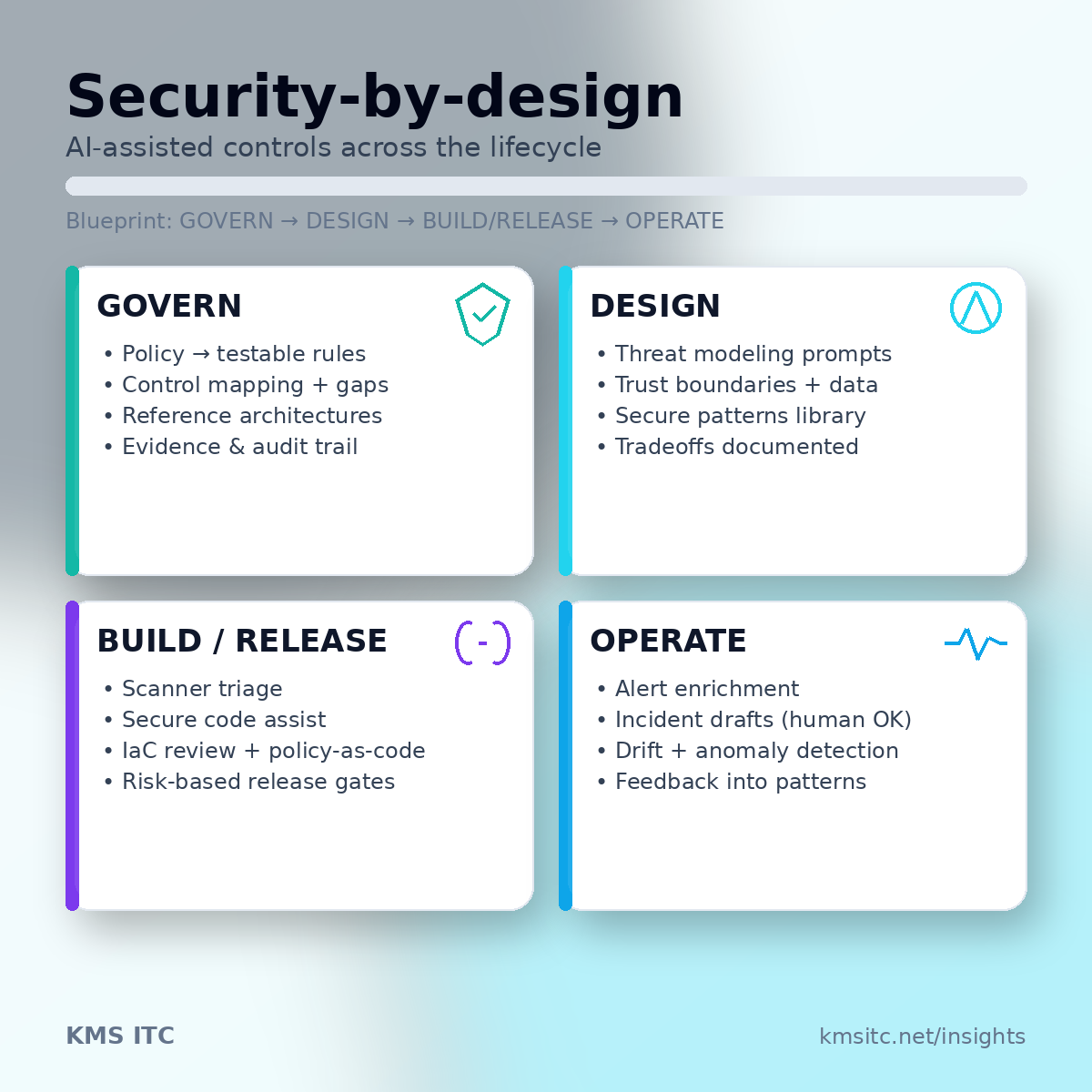
Security-by-design only works when it is built into the delivery system, not bolted onto the end of a project.
AI changes the economics of doing that well.
Used correctly, AI can make security-by-design cheaper and more consistent by turning security work into:
- continuous checks (instead of occasional reviews)
- reusable patterns (instead of bespoke one-offs)
- fast feedback (instead of stage-gate delays)
Used poorly, AI can also create new failure modes: data leakage, unsafe recommendations, and false confidence.
This article lays out a practical enterprise architecture blueprint: how to embed cyber security across the full lifecycle, and where AI fits without becoming a risk multiplier.
Executive summary
- Security-by-design is an operating model, not a checklist. The goal is to reduce exploitable defects before release, and reduce the blast radius when defects inevitably exist.
- The best lifecycle anchor is a recognised practice model (e.g. NIST SSDF for secure development outcomes, OWASP SAMM for maturity structure). AI should accelerate those practices, not replace them.
- AI is most valuable where security work is repetitive: control mapping, requirements decomposition, threat modeling prompts, secure design pattern selection, code review assistance, IaC review, log triage.
- AI must be governed like any other dependency: data boundaries, model choice, evaluation, auditability, and change control.
What changed
Two things shifted at the same time:
- Security moved “left” in expectations
Regulators, customers, and boards increasingly expect producers to reduce vulnerabilities systematically, not just respond quickly after incidents. Frameworks like the NIST Secure Software Development Framework (SSDF) describe secure development as a set of outcomes that should be integrated into any SDLC implementation.
- AI made security work scalable (and risky)
GenAI can now assist with text-heavy and analysis-heavy work that previously did not scale: requirements interpretation, architecture reasoning, documentation generation, and triage.
That creates a new opportunity:
- embed security work in day-to-day delivery flows
And a new risk:
- teams may ship AI-generated security artefacts that are confident but wrong.
Why it matters
Enterprise architecture is where security either becomes:
- a system design property (resilient, defendable, observable), or
- a late-stage compliance artifact (paper security)
When security is late-stage, you usually see predictable symptoms:
- “security review” becomes a bottleneck
- compensating controls proliferate (WAF rules, exceptions, manual approvals)
- incident response relies on heroics
- teams distrust security because it arrives as rework
Security-by-design flips this by making security continuous:
- standard patterns for identity, network segmentation, secrets, logging
- automated checks for code and infrastructure
- release gates aligned to risk
AI can accelerate this shift, but only if it is integrated into governance, design, delivery, and operations.
What to do (a lifecycle blueprint)
Think in four lifecycle domains that your enterprise architecture can standardise.
1) GOVERN: make security requirements machine-checkable
Target outcome: security policy is expressed as rules and patterns that can be applied repeatedly.
Do this:
- Define a security-by-design policy set: identity, data classification, encryption, logging, privileged access, third-party dependencies.
- Map policy to your delivery practices (SSDF outcomes, SAMM practices).
- Create a small set of reference architectures (landing zone, app baseline, data platform baseline).
Where AI helps:
- Draft policy → convert to clear control statements and testable acceptance criteria.
- Control mapping and gap analysis: “what does this architecture need to meet control X?”
- Produce developer-facing guidance that is consistent and updated.
Guardrails:
- Treat AI outputs as drafts, requiring accountable sign-off.
- Ensure the AI system cannot exfiltrate sensitive policy, incident, or customer data.
2) DESIGN: make threat modeling and architecture review routine
Target outcome: security is designed into the solution before build begins.
Do this:
- Standardise threat modeling (scope, assets, trust boundaries, abuse cases).
- Build reusable patterns: MFA, service-to-service auth, secrets, network zones, audit trails.
- Require architecture decisions to include security tradeoffs (what you accept, what you mitigate, what you transfer).
Where AI helps:
- Rapid first-pass threat modeling prompts (STRIDE-style questions, abuse case brainstorming).
- Design linting: check designs for common omissions (logging, key management, admin paths, data egress controls).
- Generate “security non-functional requirements” from business context and data classification.
Guardrails:
- Threat models can contain sensitive system details; use private models/environments.
- Validate AI-generated threats against real incident patterns and your environment.
3) BUILD & RELEASE: make security continuous in the pipeline
Target outcome: security is enforced through automation and gates, not meetings.
Do this:
- Adopt secure development outcomes aligned to NIST SSDF.
- Use automated scanning and policy-as-code: SAST, dependency scanning (SBOM), IaC scanning, secrets scanning.
- Gate releases by risk: higher-risk systems require stronger evidence.
Where AI helps:
- Triage and deduplicate findings (reduce “scanner noise”).
- Assist secure code review by explaining exploitability and suggesting safer patterns.
- Provide developer-friendly remediation guidance (with links to internal patterns).
Guardrails:
- Never allow AI to auto-approve security exceptions.
- Measure AI performance: false positives, false negatives, time-to-remediate impact.
4) OPERATE: make detection, response, and hardening feedback loops real
Target outcome: operations signals improve architecture and delivery practices.
Do this:
- Standardise logging and audit trails (what gets logged, where, retention, access).
- Run incident management as a discipline (roles, playbooks, exercises).
- Feed operational lessons back into patterns and pipeline gates.
Where AI helps:
- Alert triage and enrichment: summarise related events, map to known tactics.
- Faster incident comms drafts (internal updates, timelines) with human approval.
- Post-incident analysis: generate candidate corrective actions and pattern updates.
Guardrails:
- Protect sensitive telemetry and incident data.
- Ensure AI-based triage does not become an unreviewed decision-maker.
Risks and tradeoffs
Risk 1: AI produces plausible-but-wrong security guidance
Mitigations:
- restrict AI to approved knowledge sources (internal patterns + curated external references)
- require human sign-off for security decisions
- evaluate AI recommendations periodically using a test set of scenarios
Risk 2: data leakage (architectures, incidents, customer data)
Mitigations:
- classify data and define what can be used as model input
- use private deployments or approved vendors with contractual controls
- apply redaction for logs and tickets; enforce retention policies
Risk 3: governance drift (model changes without change control)
Mitigations:
- treat models/prompts as versioned artefacts
- record evidence: what model, what prompt, what inputs were used
- apply release management to AI tooling that affects security decisions
Risk 4: “security theatre” at scale
If AI makes it easy to generate documents, it can also make it easy to produce security artefacts that are not tied to enforcement.
Mitigations:
- prioritise machine-checkable controls and pipeline gates
- tie security outcomes to operational metrics (vuln trends, incident trends, MTTD/MTTR)