
AI Strategy
Soul files, heartbeats, and why assistants are becoming ‘someone’: the agent OS pattern
The next jump in personal/work assistants won’t come from a smarter model. It’ll come from an operating model: durable identity contracts, memory layers, and background loops that surface only what matters.
Most AI assistants still behave like a request/response API: you ask, it answers, and it disappears.
The more interesting pattern is emerging in assistant runtimes like OpenClaw: an assistant that can stay quiet, keep state, run background tasks, and act with explicit constraints.
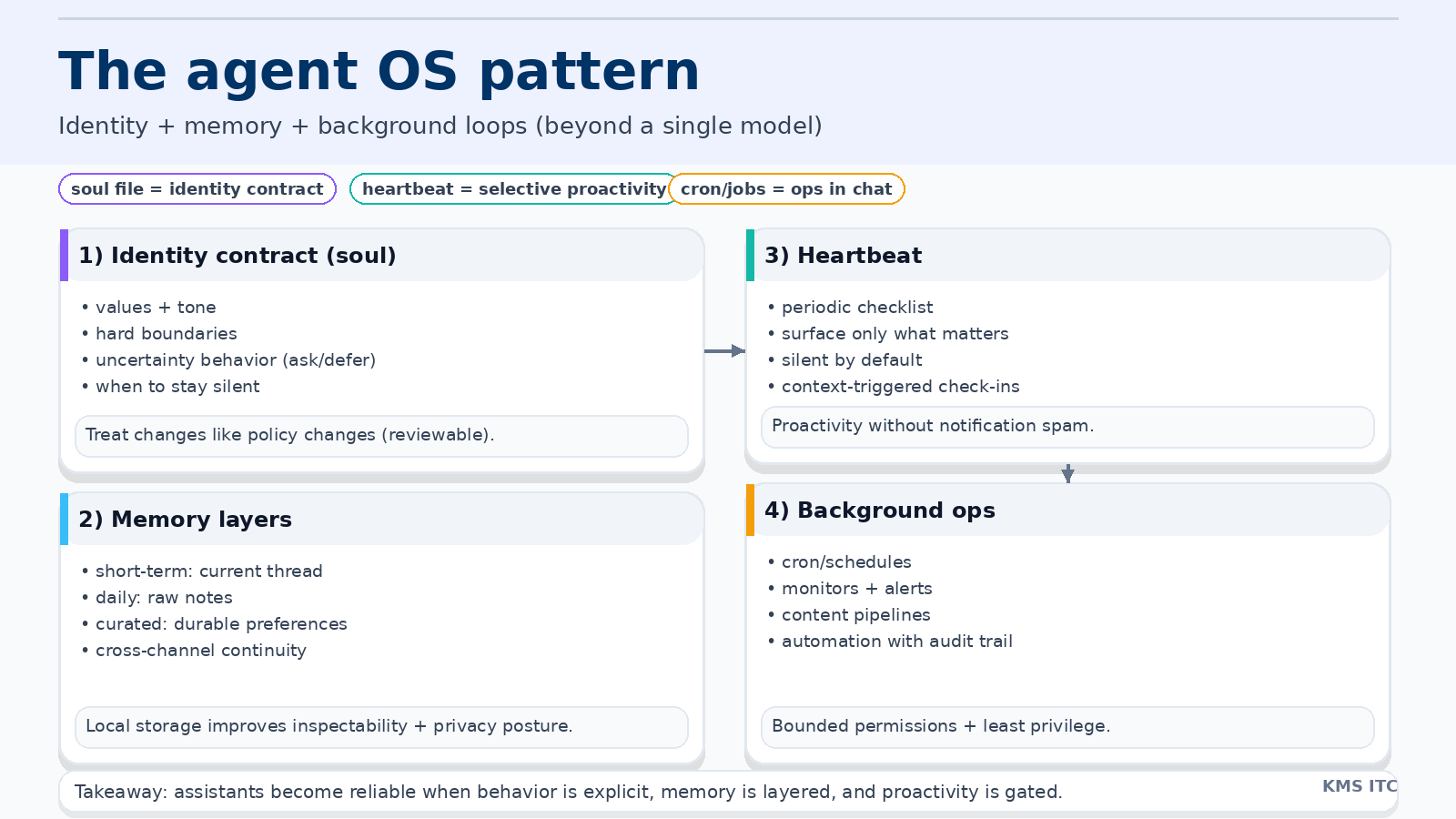
A useful way to describe this is an agent OS: not a single "smart model", but a coherent operating model made of identity, memory, and background loops.
Executive summary
A next-generation assistant needs three things to feel reliable over time:
- A durable identity contract (a "soul file") that encodes values, tone, and boundaries.
- Memory layers that preserve continuity across sessions and channels.
- Background loops (heartbeat + cron/jobs) that keep watch without spamming you.
Put together, the assistant stops feeling like "a chatbot" and starts behaving like "someone you work with"\u2014without pretending to be human.
1) Why prompts aren\u2019t enough
Prompting can produce good answers, but it does not produce stable behavior.
The failure modes are familiar:
- the assistant forgets what matters across days
- it interrupts too often (notification spam) or never at all (purely reactive)
- it overreaches when uncertain
- its "personality" shifts depending on the model and context window
An identity contract is a compact, durable spec that answers:
- Who am I (tone, values)?
- What will I never do (hard boundaries)?
- What do I do when I\u2019m uncertain (ask, defer, escalate)?
- When should I stay silent?
Some systems embody this as a soul.md file: a living document the assistant reads at startup and evolves deliberately over time.
2) Heartbeat: proactivity without spam
The most practical design move is not "be more proactive". It\u2019s be selectively proactive.
A heartbeat is a periodic check that:
- loads a short checklist (urgent messages, calendar, follow-ups, monitors)
- decides if anything is worth interrupting you for
- stays silent if not
This creates a middle ground between:
- annoying bots that ping on a timer
- assistants that only exist when you ask
Pattern: background vigilance + selective surfacing.
3) Cron/background tasks: assistants as \u201cops in chat\u201d
Once you accept that an assistant should keep working when you\u2019re not chatting, scheduling stops being a feature and becomes core infrastructure.
Examples:
- monitoring something you care about and notifying only on meaningful changes
- a publishing pipeline that takes drafts to PR-ready content
- reminders that use context (not just a timestamp)
The key difference: these jobs should be bounded (permissions, scopes) and auditable.
4) Memory layers: continuity you can inspect
A mature assistant does not "remember" in a single bucket.
Instead, it uses layers:
- short-term: the current conversation
- daily notes: what happened recently (raw)
- curated long-term: stable preferences, decisions, ongoing projects
When memory is stored locally (e.g., markdown files under a workspace), you get:
- portability
- inspectability (you can edit what it remembers)
- a clearer privacy posture
The trade-off is responsibility: retention, access controls, and backups become real engineering concerns.
5) Self-awareness: the agent knows its harness
The boundary between "model" and "system" is where many agent failures occur.
A self-aware assistant is capable of reasoning about:
- what tools it has
- what permissions are enabled
- where its docs and configuration live
- what mode it\u2019s running in (safe/verbose/reasoning)
This reduces the gap between what the assistant assumes it can do and what it\u2019s actually allowed to do.
6) \u201cSoul\u201d is not just vibe \u2014 it\u2019s governance
The interesting product insight is that "soul" is not just tone. It\u2019s a boundary contract.
In enterprise terms, it maps cleanly to:
- policy-as-code for agent behavior
- escalation rules
- human-in-the-loop constraints
- "never do X" clauses
- privacy red lines
The format (markdown vs JSON vs YAML) matters less than the outcome: behavior must be explicit and increasingly testable.
7) A practical agent OS blueprint
If you\u2019re building or evaluating assistants, look for these layers:
- Identity contract ("soul file") \u2014 values, tone, boundaries, escalation
- Memory layers \u2014 short-term, daily, curated long-term
- Heartbeat \u2014 periodic check + selective surfacing
- Cron/background jobs \u2014 monitoring + workflows + reminders
- Tools + permissions \u2014 allowlists, approvals, blast radius control
- Evaluation loop (optional but powerful) \u2014 regression tests for agent behavior
Risks & trade-offs
- Power increases blast radius: background jobs + tool access require least-privilege design.
- Identity can ossify: treat identity changes like policy changes (reviewable, versioned).
- Over-personification risk: assistants can feel "alive" without being treated as human decision-makers.
Closing takeaway
As AI makes knowledge cheap, what stays scarce is agency: what gets done, reliably, under constraints.
The next-generation assistant isn\u2019t "a smarter chatbot". It\u2019s an operating model: memory + background loops + explicit identity and boundaries.