
Enterprise Architecture
Provisioned Throughput for LLMs: the missing layer between SLOs and FinOps
On-demand LLM inference is great for experiments—and brutal for production SLOs. Provisioned throughput turns capacity into an architectural primitive: predictable latency, deliberate burst handling, and a budget you can actually govern.
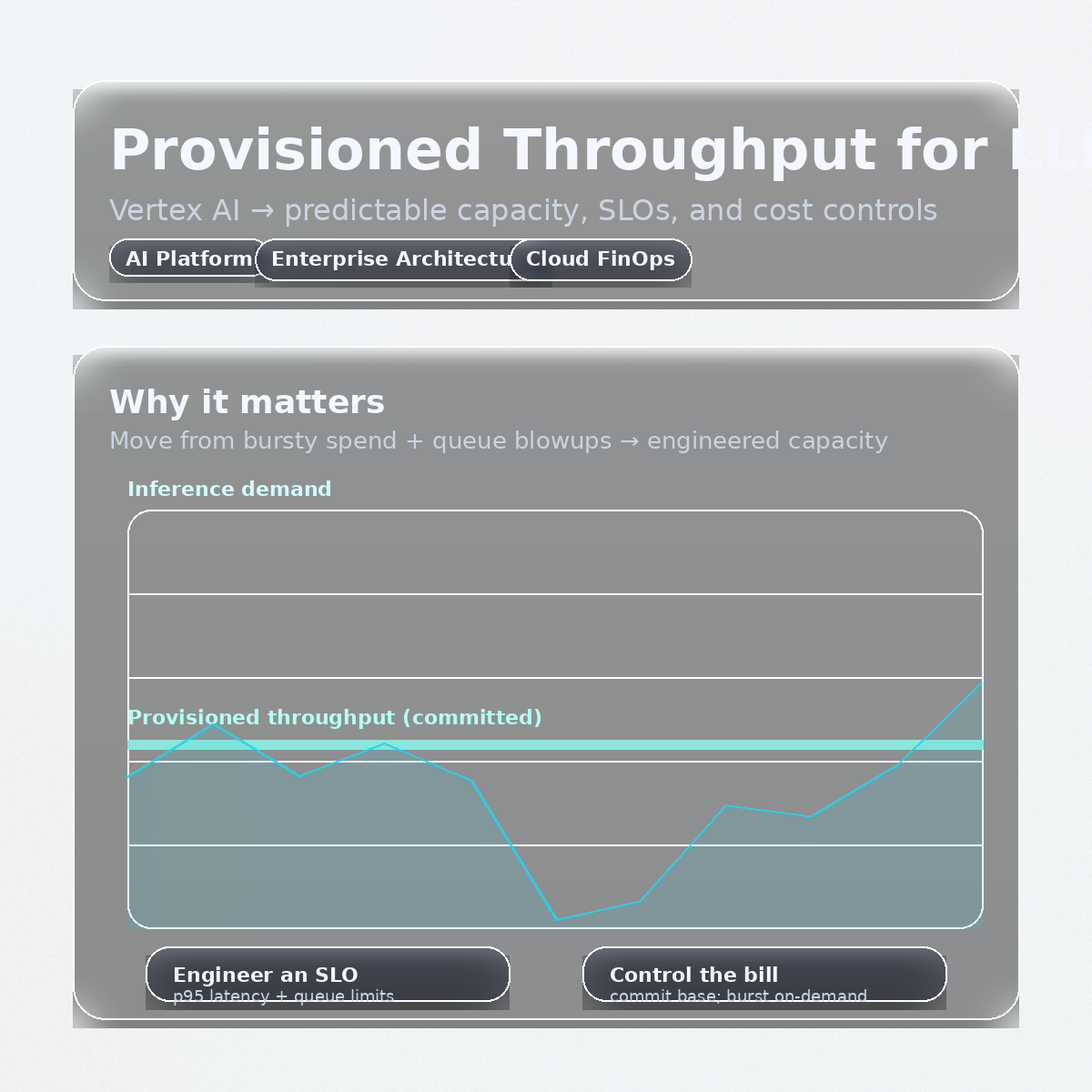
If you’re building internal copilots or agentic workflows, you’ve already felt the tension:
- Product wants fast responses and no waiting.
- Finance wants predictable spend.
- Platform wants reliability (and fewer 2am incidents).
On-demand LLM inference is fantastic for prototypes—but in production it behaves like an “infinite variable cost service” with latency variance and capacity uncertainty.
Provisioned throughput changes the game: it makes inference capacity something you engineer—not something you hope scales.
1) The architectural problem: SLOs don’t survive “best effort capacity”
When demand spikes (launches, payroll week, quarter-end, incident floods), a typical LLM stack fails in predictable ways:
- Queue growth → timeouts → retries → amplified load.
- p95 latency balloons, even if average looks “fine”.
- Teams add ad-hoc workarounds: caching here, bigger limits there, “just increase the budget”.
The root cause isn’t your prompt.
It’s that you’re running an SLO-bound workload on opportunistic capacity.
2) Provisioned throughput: capacity as a first-class platform primitive
Provisioned throughput is essentially a commitment model for inference:
- You reserve a baseline of capacity for steady traffic.
- You design explicit handling for burst traffic (overflow → on-demand, degrade paths, or queue caps).
In enterprise terms, you’re moving inference from:
- “shared public lane”
to
- “reserved lane + controlled overflow”
That unlocks real platform behaviors:
- Latency targets you can defend (because capacity is not accidental).
- FinOps you can govern (because there is a defined base load).
- Change management (because scaling is an intentional decision, not a panic reaction).
3) The key design move: separate base load from burst (and treat them differently)
Most enterprise GenAI traffic is a mix of:
- Base load: steady internal usage (helpdesk copilot, dev assistant, search augmentation).
- Burst: events (all-hands Q&A, outage triage, marketing launches, regulatory deadlines).
If you treat them the same, you’ll overpay for “always-on peak”, or you’ll underserve users when it matters.
A better pattern:
- Put the base load on provisioned capacity.
- Route burst into a controlled overflow path.
- Apply guardrails that preserve system health and budget.
4) Reference architecture: LLM capacity routing (the CTO-friendly version)
The architecture shift isn’t “turn on a feature”. It’s introducing a platform layer that enforces policy and SLOs.
LLM capacity routing — reference architecture:
Incoming requests (chat / RAG / agents / batch)
                    │
                    ▼
         ┌──────────────────────┐
         │   Gateway / Control  │
         │   Plane              │
         │  ┌────────────────┐  │
         │  │ Routing policy │  │
         │  │ Tenant quotas  │  │
         │  │ Budget limits  │  │
         │  │ Circuit breaks │  │
         │  └────────────────┘  │
         └──────┬──────────┬────┘
                │          │
      ┌─────────▼──┐   ┌───▼─────────────────┐
      │ Provisioned│   │ On-demand overflow   │
      │ capacity   │   │ (or smaller model /  │
      │ (base load)│   │  cached responses)   │
      └────────────┘   └─────────────────────┘
What’s new here is the gateway. It becomes the control plane for:
- Routing: provisioned-first, then overflow.
- Guardrails: queue caps, timeouts, circuit breakers.
- Governance: tenant-level policy, budget enforcement, and prompt/tool versioning.
- Observability: trace IDs + request tagging so you can answer “what did this cost and why?”
5) The “three knobs” you must standardise (or you’ll just shift the pain)
Knob A — Admission control (protect reliability)
Define what happens when you’re saturated:
- Hard queue limits per tenant/workload
- Explicit timeouts by use case (chat vs batch)
- Backpressure (429 + retry-after) instead of silent queuing
Knob B — Degradation paths (protect user experience)
Design fallbacks deliberately:
- Smaller/cheaper model for overflow
- Shorter max output tokens
- Turn off tools/function-calls for overflow tier
- Serve cached answers for common intents
Knob C — Cost envelopes (protect the business)
Make cost a platform constraint, not a monthly surprise:
- Budget ceilings by tenant and environment
- Default quotas for new apps (sandbox → production promotion)
- “Spend per successful outcome” tracking (tickets resolved, code merged, time saved)
6) What to do next: an enterprise rollout checklist
If you’re a CTO / EA / platform lead, here’s the pragmatic sequence:
- Classify workloads into tiers (internal, customer-facing, regulated) with explicit SLO + budget targets.
- Instrument the gateway (request IDs, tenant tags, tokens-in/out, model, tool use, latency).
- Estimate base load from real traffic (not forecasts): steady QPS + typical token volume.
- Provision capacity for base load; route overflow to on-demand.
- Define saturation behavior (queue caps + timeouts + 429 strategy) and test it.
- Add safe degradation (smaller model, capped output, cached responses).
- Turn on governance (budgets, quotas, and a promotion process from sandbox → production).
The takeaway
Provisioned throughput isn’t just a pricing detail—it’s an architecture lever.
It lets you align three things that usually fight each other:
- SLOs (predictable latency)
- Platform engineering (operational control)
- FinOps (predictable spend)
Sources
If you want a one-page capacity routing policy template (tiers, overflow rules, degradation paths, and budget envelopes), reach out via /contact and include your cloud (AWS/Azure/GCP) and whether your primary workloads are chat, RAG, or agents.